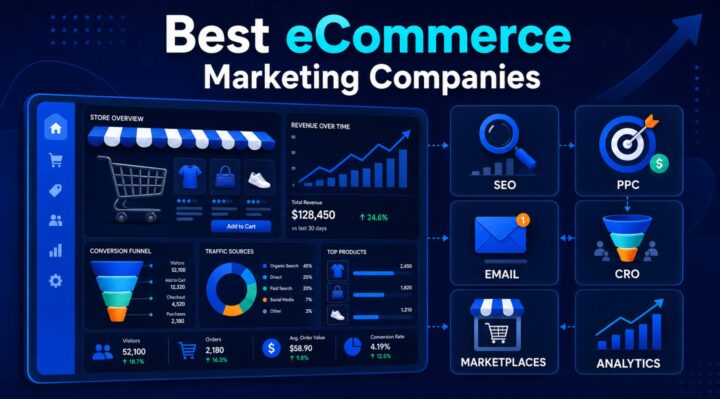
Online retail keeps getting more competitive. Merchants now compete across traditional search, AI-generated answers, Google Shopping, social feeds, marketplaces, email inboxes, and retail media networks. A store may have a strong product and still struggle because acquisition costs rise, product feeds contain errors, category pages fail to rank, or visitors leave before checkout. Scaling also requires several specialist skills at once. Search engine optimisation must account for product variants, faceted navigation, structured data, out-of-stock pages, and site migrations. Paid media teams need accurate feeds, creative testing, attribution, and margin-aware bidding. Retention depends on relevant email and SMS flows, while conversion rate optimisation (CRO) must turn more existing traffic into revenue.
The best eCommerce marketing companies bring these disciplines together. However, they differ considerably in scale, channel depth, platform experience, pricing transparency, and the types of businesses they serve. An enterprise DTC brand investing heavily in retail media needs a different partner from a growing Shopify store seeking affordable SEO and paid search support.
Online retailers often require expertise across search, advertising, content, analytics, and customer retention. Working with a suitable digital marketing agency can help a business coordinate these channels, control acquisition costs, and connect marketing activity with measurable revenue.
This independent comparison evaluates eight agencies using publicly available information checked in August 2026. It covers services, eCommerce platforms, pricing, strengths, limitations, and ideal client profiles. When an agency does not publicly confirm a capability or price, it is marked as “not publicly disclosed” rather than inferred.
Compare the Best eCommerce Marketing Companies
| Company | Best for | Core services | Public pricing | Overall rating* |
|---|---|---|---|---|
| WebFX | Best overall for integrated, measurable growth | SEO, PPC, Shopping, email, social, CRO, content, analytics | eCommerce marketing commonly $2,500–$12,000/month; eCommerce SEO plans from $2,500/month | 4.8/5 |
| NP Digital | Global and enterprise search-led growth | SEO, paid search, paid social, marketplaces, content, creative, analytics | Custom pricing | 4.7/5 |
| Inflow | eCommerce SEO, PPC, and CRO specialisation | SEO, paid media, CRO, email, analytics | SEO guidance commonly $3,000–$5,000/month; exact proposal is custom | 4.7/5 |
| Megrisoft | Value-conscious businesses needing flexible global support | eCommerce SEO, PPC, social, influencer outreach, content, development | Custom pricing | 4.6/5 |
| SubmitShop | SEO, outreach, and flexible multichannel support | SEO, paid search, content outreach, digital PR, CRO, social, email | Custom pricing | 4.5/5 |
| Tinuiti | Enterprise retail media and marketplace advertising | Paid search, paid social, Amazon, Walmart, streaming, lifecycle, measurement | Custom pricing | 4.8/5 |
| Coalition Technologies | Shopify SEO plus development support | SEO, PPC, email, social, web design and development | Typical eCommerce SEO campaign averages about $2,500/month | 4.6/5 |
| Disruptive Advertising | Performance advertising without a long-term commitment | Paid search, paid social, SEO, lifecycle marketing, CRO, creative | Custom pricing | 4.6/5 |
*Ratings are editorial assessments, not customer-review averages. They reflect the methodology below and should not be treated as guarantees of results.
How We Evaluated the Best eCommerce Marketing Companies
We reviewed official service pages, company pages, public case studies, published pricing, platform references, and credible company profiles. We gave the greatest weight to evidence directly relevant to online retail rather than broad claims about digital marketing.
The assessment considered:
- Experience and reputation: years in business, depth of specialist teams, public recognition, partnerships, and accessible case studies.
- eCommerce expertise: evidence of work with online retailers, DTC brands, complex catalogues, shopping feeds, migrations, and revenue-focused measurement.
- SEO capabilities: technical SEO, product and category optimisation, content, digital PR or link acquisition, and eCommerce platform knowledge.
- Paid advertising: paid search, Google Shopping or Performance Max, paid social, creative, feed optimisation, and campaign measurement.
- Retention marketing: clearly documented email, lifecycle, and SMS services.
- Marketplace marketing: verified support for Amazon, Walmart, or other retail media networks.
- CRO and analytics: experimentation, landing-page improvement, attribution, reporting, and access to proprietary or third-party measurement tools.
- Transparency and value: public pricing, clear service descriptions, contract information, reporting detail, and suitability across budgets.
- Scalability: capacity to support startups, mid-market companies, international operations, or large enterprise media programmes.
No agency can be objectively “best” for every merchant. The ratings indicate comparative service breadth and fit, not an assurance of performance. Results depend on budget, competition, margins, site quality, internal resources, and execution.
1. WebFX — Best Overall for Integrated eCommerce Growth
Company Overview
WebFX is a US-based digital marketing agency with more than 30 years of experience. Its official eCommerce material describes a team of more than 750 digital specialists and services spanning SEO, PPC, social media, web design, email, content, and measurement. The company also promotes RevenueCloudFX, its in-house revenue intelligence and attribution platform.
This combination gives WebFX one of the broadest verified service sets in the comparison. It is particularly relevant to merchants that want one partner to coordinate acquisition, conversion, and reporting rather than hiring separate SEO, paid media, and development vendors.
Best for: Established small businesses, mid-market retailers, and enterprise teams seeking full-service execution with clear revenue reporting.
Core Services and Channel Coverage
SEO: WebFX publishes dedicated eCommerce SEO plans covering keyword research, on-page implementation, technical work, content, and performance reporting. It explicitly states experience with Shopify, WordPress/WooCommerce, BigCommerce, and other eCommerce systems.
PPC, Google Shopping, and Meta Ads: PPC and social advertising are part of its eCommerce marketing offering. Google Shopping support is documented across its paid-media resources. Because the official Google Merchant Center product data specification requires accurate and correctly formatted product information, merchants should confirm whether the proposal covers feed management, pricing updates, availability, product identifiers, disapprovals, and creative production.
Email, SMS, and content: Email marketing and content creation are publicly offered. SMS-specific eCommerce programme details are less prominent, so merchants should verify whether SMS strategy and execution are included or handled through a technology partner.
CRO and analytics: CRO, web design, and revenue tracking are major strengths. Reporting can include online sales, leads, average order value, and ROI. RevenueCloudFX is designed to connect marketing activity with commercial outcomes.
Marketplace marketing: WebFX publicly promotes Amazon advertising capabilities and is identified on its site as an Amazon Ads verified partner. Walmart marketplace depth is not as clearly documented as at Tinuiti.
Industries and Supported Platforms
WebFX works across retail and many B2B and consumer industries. Its public eCommerce pages mention Shopify, WordPress/WooCommerce, and BigCommerce; additional platforms should be verified for the proposed team.
Pros
- One of the most complete combinations of SEO, paid media, content, email, CRO, development, and analytics.
- Published eCommerce pricing gives buyers a useful budget benchmark.
- Large specialist team and proprietary reporting technology support scalability.
- Public case studies and revenue-oriented reporting improve evaluation transparency.
Cons
- The breadth and technology layer may be more than a very small store needs.
- Monthly investment can exceed the budget of early-stage merchants.
- SMS and Walmart-specific execution require proposal-level confirmation.
Pricing
WebFX states that eCommerce digital marketing commonly costs $2,500 to $12,000 per month. Its dedicated eCommerce SEO page lists plans starting around $2,500 per month, with higher or custom pricing for larger stores. Scope, content volume, advertising management, and technology access affect the final quote.
Why Choose WebFX
Choose WebFX when integrated execution and measurable revenue attribution matter more than hiring a narrow channel specialist. It offers the best overall balance of service depth, public pricing, platform familiarity, and scalability in this group.
Best fit: Established small business, mid-market, and enterprise
Overall rating: 4.8/5 — Services 4.9, expertise 4.8, transparency 4.8, value 4.5, scalability 4.9
2. NP Digital — Best for Global, Search-Led Enterprise Growth
Company Overview
NP Digital was co-founded in 2017 by Neil Patel. Its official company page reports more than 1,000 employees, over 500 clients, and operations across 28 countries as of 2026. The agency organises its work around earned media, paid media, creative, data and analytics, and technology.
For eCommerce businesses, its value lies in combining large-scale SEO and content capabilities with paid search, paid social, and marketplace advertising. Its public work includes eCommerce brands such as ZAGG and Modkat. In the Modkat case study, the agency reports a 60% increase in eCommerce conversions from an SEO programme; as with any vendor case study, the outcome should be treated as client-specific rather than typical.
Best for: International, mid-market, and enterprise brands that need sophisticated search, content, paid media, and analytics across markets.
Core Services and Channel Coverage
SEO and content: SEO is a central NP Digital capability. Services include technical SEO, content strategy, digital PR, and organic-search programmes. Its global footprint can help businesses that require localisation or multi-country coordination.
PPC, Google Shopping, and Meta Ads: NP Digital publicly documents paid search and paid social services. Its paid-media practice covers Google, Meta, Amazon, and other platforms. Google Shopping activity may be included within a commerce or paid-search scope, but merchants should request explicit deliverables for product feeds and Merchant Center management.
Email and SMS: Lifecycle or email execution is less prominent on the main global service navigation than search and paid media. Buyers should not assume full email or SMS management without confirming the regional team, technology stack, and deliverables.
CRO and analytics: Data, insights, experimentation, and creative optimisation form part of the broader offering. CRO availability should be scoped by market and engagement. NP Digital is particularly suited to organisations that already have analytics maturity and want an agency to connect channel data with business outcomes.
Marketplace marketing: The agency has a dedicated marketplaces service describing listing optimisation, targeting, ad placements, and ongoing refinement. Amazon is explicitly referenced. The precise Walmart, Instacart, or retailer-network scope varies and should be confirmed.
Industries and Supported Platforms
NP Digital serves multiple consumer and B2B sectors. Public eCommerce case studies demonstrate online-retail experience, but its main pages do not provide a definitive list of supported Shopify, WooCommerce, Magento, and BigCommerce implementations. Platform-specific development should therefore be verified separately.
Pros
- Strong global scale and international market coverage.
- Deep SEO, content, paid media, creative, and analytics resources.
- Verified marketplace advertising capability.
- Substantial portfolio of public work and industry recognition.
Cons
- Pricing is not publicly disclosed.
- May be too complex or costly for small stores with limited channel budgets.
- Platform development, email, and SMS deliverables are not equally prominent across public service pages.
Pricing
Custom pricing; not publicly disclosed. Ask for the agency fee, required media spend, creative costs, technology fees, and any regional minimums separately.
Why Choose NP Digital
NP Digital is a strong choice when search visibility, content, paid media, and international coordination must operate under one strategy. It is less compelling for a small merchant seeking a low-cost, platform-development-led package.
Best fit: Mid-market and enterprise
Overall rating: 4.7/5 — Services 4.7, expertise 4.9, transparency 4.3, value 4.3, scalability 5.0
3. Inflow — Best Specialist for eCommerce SEO, PPC, and CRO
Company Overview
Founded in 2007, Inflow positions itself as a digital marketing agency for eCommerce and lead-generation businesses. Its eCommerce practice centres on SEO, paid media, CRO, and email rather than trying to cover every general agency discipline.
This specialisation is useful for stores with an existing website and internal brand resources that need experienced performance marketers. Inflow publishes detailed educational material and eCommerce case studies, including a Magento-to-Shopify migration case study reporting a 126% increase in organic traffic. That result provides evidence of platform-migration experience but should not be treated as a forecast for other sites.
Best for: Mid-market retailers that need specialist SEO, paid advertising, CRO, or email support without an enterprise holding-company structure.
Core Services and Channel Coverage
SEO and content: Inflow offers technical SEO, keyword and content strategy, eCommerce architecture, migration support, and ongoing optimisation. Its public resources demonstrate familiarity with catalogue issues such as out-of-stock products, category structure, and Shopify optimisation.
PPC, Google Shopping, and Meta Ads: Full-service PPC management is a core offering. Paid search, shopping campaigns, paid social, feed-focused work, and ongoing optimisation are within its published capabilities. Confirm whether creative asset production is included or requires client-supplied assets.
Email and SMS: Inflow has a dedicated email marketing service focused on segmentation, testing, personalisation, and sales. SMS marketing is not prominently documented as a standalone service; it should be marked not publicly confirmed unless included in the proposal.
CRO and analytics: CRO is one of Inflow’s strongest differentiators. Services include research, testing, user-experience analysis, and conversion improvement. Reporting and measurement support its SEO and paid-media programmes, although it does not promote an attribution platform of the same scale as WebFX or Tinuiti.
Marketplace marketing: Amazon and Walmart management are not presented as primary standalone practices. Inflow is therefore a better fit for owned-store growth than marketplace-first expansion.
Industries and Supported Platforms
The agency focuses heavily on eCommerce. Public content and case studies show experience with Shopify and Magento, while its educational resources also address other mainstream eCommerce environments. Buyers using WooCommerce or BigCommerce should request examples from the proposed team.
Pros
- Concentrated eCommerce knowledge rather than a generic industry offering.
- Strong combination of SEO, PPC, CRO, and email.
- Useful public case studies and transparent educational content.
- Published SEO budget guidance helps qualify fit before a sales call.
Cons
- Limited public evidence of dedicated Amazon or Walmart marketplace management.
- SMS is not clearly offered as a standalone service.
- Not the broadest option for web development, influencer marketing, or global enterprise media.
Pricing
Inflow states that effective SEO engagements generally cost $3,000 to $5,000 per month, with larger eCommerce sites potentially costing more. Exact eCommerce SEO, PPC, CRO, and email proposals use custom pricing.
Why Choose Inflow
Choose Inflow when the core problem is organic visibility, paid-media efficiency, or on-site conversion. Its narrower focus may produce a better specialist fit than a larger full-service agency, provided marketplace management is not the priority.
Best fit: Mid-market and established eCommerce businesses
Overall rating: 4.7/5 — Services 4.6, expertise 4.9, transparency 4.7, value 4.6, scalability 4.5
4. Megrisoft — Best Value-Oriented Global Support
Company Overview
Megrisoft is an IT and digital marketing company established in 1992. Its official corporate and service pages describe web design, development, eCommerce, SEO, PPC, social media, advertising, influencer marketing, and blogger outreach services for international clients.
The company publicly documents eCommerce development capabilities for Magento, Shopify, PrestaShop, and OpenCart. Its marketing page also lists a dedicated eCommerce SEO service. This makes Megrisoft relevant to cost-conscious stores that want development and organic marketing support from a long-established provider.
Best for: Small and mid-sized online businesses seeking flexible eCommerce SEO, paid search, social, outreach, and development support across time zones.
Core Services and Channel Coverage
SEO and content: Megrisoft offers organic and technical SEO, eCommerce SEO, content, blogger outreach, influencer work, and digital PR-related support. These services can suit stores that need visibility and authority building as well as site optimisation.
PPC, Google Shopping, and Meta Ads: The agency publicly offers Google Ads, Bing Ads, and paid social campaign management. Google Shopping and Meta-specific eCommerce deliverables are not described in enough detail to assume full feed and creative management; they should be defined in the proposal.
Email and SMS: Email marketing is referenced within the broader service group, but a detailed eCommerce lifecycle programme is not prominent. SMS marketing is not publicly confirmed.
CRO and analytics: Analytics and conversion-focused services are referenced across Megrisoft and its associated brand material. Buyers should request a sample report, testing process, analytics implementation scope, and named KPIs because public operational detail is limited.
Marketplace marketing: Marketplace services are not clearly documented on Megrisoft’s principal digital-marketing page. Amazon and Walmart seller operations should be treated as not publicly confirmed.
Industries and Supported Platforms
Megrisoft works across industries and international markets. It explicitly lists Magento, Shopify, PrestaShop, and OpenCart for eCommerce development. WooCommerce and BigCommerce marketing expertise should be verified for the assigned team.
Pros
- More than three decades in web and IT services.
- Combines eCommerce development with SEO, PPC, social, content, and outreach.
- Multiple supported store platforms are publicly named.
- Likely to appeal to businesses seeking flexible, globally delivered support.
Cons
- Pricing, service minimums, and contract terms are not public.
- Fewer detailed, current eCommerce case studies and quantified outcomes are visible than for higher-ranked agencies.
- SMS, marketplace operations, and detailed Google Shopping execution are not clearly confirmed.
Pricing
Custom pricing; not publicly disclosed. Request an itemised proposal separating strategy, monthly labour, content or outreach costs, development, ad management, and media spend.
Why Choose Megrisoft
Megrisoft deserves inclusion for its longevity, platform development experience, eCommerce SEO, and broad digital services. It is best considered by buyers who value flexible delivery and web expertise, while enterprises requiring sophisticated retail-media measurement will find stronger evidence elsewhere.
Best fit: Startup, small business, and mid-market
Overall rating: 4.6/5 — Services 4.7, expertise 4.6, transparency 4.3, value 4.8, scalability 4.5
5. SubmitShop — Best for SEO, Outreach, and Flexible Support
Company Overview
SubmitShop is a full-service digital marketing agency operating as part of Megrisoft. Its official website describes more than 24 years of experience and offices or delivery operations serving clients in the United States, Canada, the United Kingdom, and India. Publicly listed capabilities include organic and technical SEO, paid search, content creation, blogger outreach, digital PR, CRO, social media, email marketing, analytics, and marketplace-related support.
Although SubmitShop and Megrisoft share the same provider group, they are included separately at the requested positions because their public positioning differs. Megrisoft presents a broader IT, development, and digital marketing offer, while SubmitShop places greater emphasis on SEO, content outreach, link acquisition, and digital promotion.
Best for: Startups, small businesses, online retailers, and marketing teams seeking SEO-led growth, content outreach, digital PR, and flexible campaign support.
Core Services and Channel Coverage
SEO and content: SEO is SubmitShop’s clearest strength. The agency publicly offers technical SEO, organic optimisation, local SEO, content creation, link building, blogger outreach, and digital PR. This range can support product and category visibility as well as off-site authority building. Merchants should ask how links and publisher placements are vetted for relevance, traffic, editorial standards, and compliance with search-engine policies.
PPC, Google Shopping, and Meta Ads: Paid search and social media marketing are publicly listed. However, detailed Google Shopping feed management, Merchant Center operations, and Meta creative-testing frameworks are not clearly described on the principal service pages. These deliverables should be confirmed in the proposal.
Email and SMS: Email marketing is included in SubmitShop’s public service list. A dedicated SMS marketing programme is not publicly confirmed.
CRO and analytics: CRO and analytics are explicitly listed. Buyers should request a sample report and clarify whether CRO includes user research, landing-page production, A/B testing, checkout analysis, and implementation support.
Marketplace marketing: Marketplace services are referenced, but detailed Amazon and Walmart operational capabilities are not publicly documented to the same level as Tinuiti. Sellers should verify whether support covers ads, listings, catalogue management, and reporting.
Industries and Supported Platforms
SubmitShop serves businesses across sectors rather than publishing a narrow industry focus. Its principal pages do not provide a definitive list of supported Shopify, WooCommerce, Magento, or BigCommerce implementations. Platform expertise should therefore be verified for the assigned team.
Pros
- More than two decades of publicly stated digital marketing experience.
- Broad SEO, content outreach, digital PR, paid search, social, email, CRO, and analytics services.
- Flexible positioning that can suit smaller and internationally distributed businesses.
- Association with Megrisoft can provide access to wider development resources.
Cons
- SubmitShop and Megrisoft are part of the same provider group, so buyers should clarify team and service boundaries.
- Public pricing and minimum engagement levels are unavailable.
- Fewer detailed, current eCommerce case studies and platform-specific examples are visible than for several larger agencies.
- SMS, Google Shopping operations, and comprehensive marketplace management require confirmation.
Pricing
Custom pricing; not publicly disclosed. Request an itemised proposal covering SEO, content and outreach costs, paid-media management, creative work, development, analytics, and media spend.
Why Choose SubmitShop
Choose SubmitShop when SEO, technical optimisation, content outreach, digital PR, and flexible multichannel support are the main requirements. It may provide good value for smaller online businesses, but buyers should verify platform experience, marketplace scope, and reporting standards before appointment.
Best fit: Startup, small business, and mid-market
Overall rating: 4.5/5 — Services 4.7, expertise 4.6, transparency 4.2, value 4.7, scalability 4.4
6. Tinuiti — Best for Enterprise Retail Media and Marketplaces
Company Overview
Tinuiti was founded in 2004 and describes itself as the largest independent full-funnel US marketing agency across major media channels. Its official material reports approximately $4 billion in digital media under management. The agency works across Google, Meta, Amazon, streaming media, lifecycle marketing, and measurement.
Tinuiti stands apart in this comparison because commerce media and marketplaces are central capabilities, not secondary add-ons. It has documented experience with Amazon, Walmart, Instacart, and other retail networks. Publicly named clients include Carter’s, TOMS, e.l.f., and The Honest Company, among other large consumer brands.
Best for: Enterprise retailers, major DTC brands, and manufacturers investing across Amazon, Walmart, retail media, paid search, paid social, and streaming.
Core Services and Channel Coverage
SEO and content: Tinuiti is better known for performance media and commerce than conventional eCommerce SEO retainers. Search strategy is extensive on the paid side, but businesses seeking technical SEO and category-page programmes should confirm the current organic-search scope.
PPC, Google Shopping, and Meta Ads: These are core strengths. Tinuiti supports large paid-search and paid-social programmes across Google and Meta, with creative, audience, media, and measurement capabilities. It is well suited to complex budgets, incrementality questions, and multi-channel planning.
Email, SMS, and lifecycle: Lifecycle marketing is a documented capability. Exact email service platforms, SMS execution, and retention deliverables depend on the engagement and are not presented through standard public packages.
CRO and analytics: Tinuiti combines media with measurement through its patented Bliss Point by Tinuiti technology. Its positioning focuses on identifying waste and understanding the point at which additional media investment stops producing efficient growth. Standalone website CRO deliverables should be confirmed.
Marketplace marketing: This is the clearest reason to shortlist Tinuiti. The agency has deep public evidence across Amazon and Walmart, including advertising partnerships, marketplace expansion, retail media strategy, and closed-loop measurement.
Industries and Supported Platforms
Tinuiti serves large consumer, retail, beauty, apparel, wellness, and digitally native brands. Its public positioning is channel and marketplace focused rather than tied to Shopify, WooCommerce, Magento, or BigCommerce development. Merchants needing storefront engineering should expect to retain an internal team or specialist partner.
Pros
- Strongest Amazon, Walmart, and retail-media depth in the comparison.
- Enterprise-scale paid search, Meta, streaming, and measurement.
- Proprietary measurement technology and large media-management footprint.
- Experience with recognised consumer and DTC brands.
Cons
- Likely unsuitable for startups or small stores with modest advertising budgets.
- Public pricing and minimum spend are not disclosed.
- Store development and traditional eCommerce SEO are not the clearest parts of its public offer.
Pricing
Custom pricing; not publicly disclosed. Enterprise buyers should request separate figures for agency fees, media minimums, creative, measurement technology, and marketplace operations.
Why Choose Tinuiti
Choose Tinuiti when Amazon, Walmart, Google, Meta, and other media channels need to be planned and measured at enterprise scale. For a smaller Shopify store focused on technical SEO or a site redesign, another agency will usually provide a closer fit.
Best fit: Enterprise
Overall rating: 4.8/5 — Services 4.8, expertise 5.0, transparency 4.3, value 4.3, scalability 5.0
7. Coalition Technologies — Best for Shopify SEO and Development
Company Overview
Coalition Technologies is a Los Angeles-based digital agency founded in 2009. It combines SEO and paid media with web design, development, email, and social marketing. Dedicated Shopify SEO material and an eCommerce-heavy portfolio make it particularly relevant to merchants that need marketing and technical store support from one supplier.
Unlike agencies that concentrate almost entirely on media buying, Coalition can address store design and development alongside acquisition. That can reduce handoff problems when SEO recommendations require theme, template, navigation, or structured-data changes.
Best for: Shopify and other eCommerce merchants that want SEO-led growth supported by design and development.
Core Services and Channel Coverage
SEO and content: SEO is Coalition’s primary public specialism. Its eCommerce work includes technical optimisation, keyword targeting, content, link acquisition, category and product improvements, and platform-specific services such as Shopify SEO.
PPC, Google Shopping, and Meta Ads: PPC, paid social, and advertising management are available. Google Shopping and social campaigns can complement SEO, although the public material provides less detail about enterprise retail-media operations than Tinuiti.
Email and SMS: Email marketing is part of the service set. SMS is not prominently documented as a dedicated eCommerce service and should be confirmed before selection.
CRO and analytics: The agency’s design, development, SEO, and paid work can support conversion improvement. Buyers wanting a formal experimentation programme should ask about research methods, test velocity, statistical standards, and the exact analytics stack.
Marketplace marketing: Public evidence is stronger for store SEO and advertising than for comprehensive Amazon or Walmart marketplace operations. Treat marketplace management as not publicly confirmed unless included in writing.
Industries and Supported Platforms
Coalition works across retail and other sectors. Its public pages demonstrate Shopify expertise, while its development practice also works with mainstream eCommerce technologies. Buyers should request platform-specific references for Magento, WooCommerce, or BigCommerce projects matching their catalogue size.
Pros
- Strong Shopify SEO positioning.
- Marketing and development can be coordinated within one agency.
- Public eCommerce SEO price benchmark is unusually transparent.
- Suitable for merchants whose technical store limitations affect marketing.
Cons
- Marketplace depth is not as well documented as its owned-store services.
- SMS capability is not clearly presented.
- Published “average” pricing is indicative, not a guaranteed package price.
Pricing
Coalition’s public estimator states that a typical nationally focused eCommerce SEO campaign averages about $2,500 per month, though catalogue size, competition, technical condition, content, and channel scope can change the quote. Broader engagements use custom pricing.
Why Choose Coalition Technologies
Coalition is a practical shortlist choice for a Shopify merchant that wants SEO, paid acquisition, and development support coordinated under one roof. It offers better platform alignment than a media-only agency, but marketplace-first brands should look elsewhere.
Best fit: Small business and mid-market
Overall rating: 4.6/5 — Services 4.7, expertise 4.7, transparency 4.7, value 4.6, scalability 4.5
8. Disruptive Advertising — Best for Flexible Performance Marketing
Company Overview
Disruptive Advertising has more than ten years of operating history and focuses on performance marketing. Its public services include paid search, paid social, SEO, lifecycle or email marketing, CRO, and creative. The agency states that clients are not required to sign a long-term contract, which is a meaningful point of differentiation for businesses concerned about rigid retainers.
Its public reviews and case-study index contains multiple online retail examples involving Google Ads, Google Shopping, Facebook Ads, email, and CRO. This provides evidence of practical eCommerce execution even though the agency also serves many non-retail sectors.
Best for: DTC and online retail brands that prioritise paid acquisition, creative testing, and conversion improvement with contract flexibility.
Core Services and Channel Coverage
SEO and content: SEO is offered, but Disruptive’s reputation and public emphasis are stronger in paid media and conversion. Businesses seeking a content-heavy technical SEO programme should compare the proposed team and deliverables with specialist agencies such as Inflow.
PPC, Google Shopping, and Meta Ads: These are leading capabilities. Public client examples cover Google Ads, Google Shopping, Facebook Ads, Bing, YouTube, and other paid channels. Creative strategy and execution can support paid-social testing.
Successful paid-social campaigns require more than advertisements and creative testing. Consistent social media engagement helps brands answer questions, manage customer feedback, strengthen trust, and learn what potential buyers expect. Merchants should confirm whether the agency manages audience interaction or focuses only on advertising.
Email and SMS: A dedicated lifecycle and email marketing service is available. SMS is associated with lifecycle marketing but the exact platforms, message volume, compliance responsibilities, and execution scope should be confirmed.
CRO and analytics: CRO is a core service, with landing-page and testing work appearing across its client examples. Analytics and reporting are built into performance engagements; buyers should ask whether reporting includes contribution margin, new-customer acquisition cost, MER, and blended revenue—not only platform ROAS.
Marketplace marketing: Amazon and Walmart management are not prominent core practices on the public service pages reviewed. Marketplace-first sellers should favour Tinuiti or request specific proof from Disruptive.
Industries and Supported Platforms
The agency serves eCommerce, home services, education, healthcare, finance, and other verticals. Its work is generally channel-focused, so Shopify, WooCommerce, Magento, or BigCommerce development support should not be assumed.
Pros
- Strong paid search, Shopping, paid social, creative, and CRO alignment.
- Public eCommerce examples across several product categories.
- No-long-term-contract positioning reduces commitment risk.
- Lifecycle marketing enables acquisition and retention coordination.
Cons
- Pricing is not public.
- Marketplace management and platform development are not clear specialisms.
- Businesses primarily seeking organic eCommerce SEO may find a specialist stronger.
Pricing
Custom pricing; not publicly disclosed. Confirm management fees, media-spend expectations, creative costs, landing-page work, and cancellation terms before signing.
Why Choose Disruptive Advertising
Disruptive is well suited to brands that need accountable performance media and CRO but do not want to enter a lengthy commitment before proving working compatibility. It is a less natural choice for marketplace operations or store engineering.
Best fit: Growth-stage small business, mid-market, and selected enterprise accounts
Overall rating: 4.6/5 — Services 4.7, expertise 4.7, transparency 4.6, value 4.6, scalability 4.6
eCommerce Marketing Agency Feature Comparison
| Agency | Best For | Key Services | Pricing |
|---|---|---|---|
| WebFX | Overall growth | SEO, PPC, CRO, email | From $2,500/month |
| NP Digital | Global brands | SEO, paid media, marketplaces | Custom |
| Inflow | eCommerce SEO | SEO, PPC, CRO, email | From $3,000/month |
| Megrisoft | Flexible support | SEO, PPC, social, development | Custom |
| SubmitShop | SEO and outreach | SEO, digital PR, content, PPC | Custom |
| Tinuiti | Enterprise retail | Retail media, Amazon, Walmart | Custom |
| Coalition Technologies | Shopify stores | SEO, PPC, development | Around $2,500/month |
| Disruptive Advertising | Performance marketing | PPC, paid social, CRO, email | Custom |
How to Choose an eCommerce Marketing Company
Start With the Commercial Constraint
Do not begin by asking which agency has the largest client list. Identify what is restricting growth. If category pages do not rank, prioritise technical eCommerce SEO. If traffic is healthy but conversion is weak, choose a CRO-led partner. If Amazon is the main revenue channel, retail-media expertise matters more than Shopify development.
Set one primary goal and several supporting measures. A paid-acquisition brief might prioritise new-customer contribution margin, supported by customer acquisition cost, conversion rate, and average order value. An SEO brief might focus on non-brand organic revenue, supported by indexation, category visibility, and assisted conversions.
Match the Agency to Your Budget and Stage
A small store should preserve enough budget for media, content, creative, and website implementation after paying the agency. An inexpensive retainer can still be poor value if it contains too few hours to create meaningful change. Conversely, an enterprise agency may introduce unnecessary process and technology for a young store.
Agency fees should be considered alongside other eCommerce business risks, including payment disputes, data security, fulfilment delays, product returns, and platform dependence. A business should maintain enough financial capacity to manage these operational risks while continuing to fund marketing, creative production, and website improvements.
Ask every shortlisted company for a 12-month cost model covering:
- Strategy and monthly management fees
- Minimum advertising spend
- Content, creative, and product-feed work
- Development and landing pages
- Email or SMS platform charges
- Analytics, dashboards, and technology fees
- Onboarding, cancellation, and out-of-scope costs
Verify Platform Expertise
Shopify, WooCommerce, Magento, and BigCommerce create different technical and operational constraints. Request examples involving the same platform, catalogue size, international setup, subscription model, or headless architecture as your store. A generic eCommerce logo on an agency page is not enough.
For migrations, ask how the agency protects URLs, metadata, internal links, structured data, analytics, product feeds, and organic rankings. Google’s recommendations for creating a clear eCommerce website structure emphasise logical connections between category, subcategory, and product pages. For Shopify, assess theme and Liquid capability. For Magento, confirm experience with indexation, layered navigation, extensions, and development releases.
Examine Industry and Marketplace Experience
Industry familiarity can shorten the learning period, especially in regulated products, beauty, apparel, supplements, luxury goods, or high-consideration purchases. However, direct-category experience may create conflicts if the agency serves a close competitor. Ask about exclusivity and data separation.
Amazon and Walmart sellers should examine operational depth. Marketplace marketing may include only ads, or it may include catalogue management, listing optimisation, brand stores, DSP, reviews, inventory coordination, and profitability reporting. Define which tasks the agency owns.
Assess Communication and Reporting
Request an anonymised report and a sample meeting agenda. Effective reporting should connect activity with revenue and profitability rather than stopping at impressions, clicks, or platform ROAS. Look for new-customer acquisition cost, blended MER, contribution margin, lifetime value, return rates, and product-level performance where data permits.
Clarify who attends meetings, who performs the work, expected response times, and how often strategy changes. A senior sales presentation does not guarantee senior day-to-day delivery.
Review Contract Flexibility and Scalability
Read the termination clause, renewal mechanism, notice period, ownership provisions, and data-access terms. The merchant should retain ownership of ad accounts, analytics properties, Merchant Center, creative files, and historical data whenever possible.
Finally, ask how the agency will scale. Growth can require international search, additional retail networks, more creative testing, advanced attribution, or lifecycle automation. The right partner should explain what changes at each stage and how fees will evolve.
Benefits of Hiring an eCommerce Marketing Agency
Faster Access to Specialist Skills
An experienced agency can assemble SEO, media buying, creative, analytics, retention, and CRO expertise faster than most businesses can recruit each role. This is valuable when a merchant needs several capabilities but cannot justify a full in-house department.
Better Coordination Across Channels
Search insights can shape paid keywords and category content. Paid campaigns can reveal products with strong demand but weak conversion. Email data can identify repeat-purchase opportunities. CRO can improve the returns from every acquisition source. A coordinated agency can convert these signals into a shared plan.
A coordinated content marketing strategy allows search, paid advertising, social media, and email teams to work towards shared commercial goals. Search data can identify useful topics, paid campaigns can reveal high-converting products, and email performance can show which messages encourage repeat purchases.
More Disciplined Testing and Measurement
Specialist teams bring testing processes, benchmarks, tools, and experience from multiple accounts. The benefit is not that every test wins; it is that hypotheses, measurement, and decisions become more systematic. Good agencies also identify tracking gaps before budgets scale.
Improved Customer Acquisition and Conversion
SEO can create durable product and category visibility, while paid search and social can reach demand immediately. Feed optimisation, landing-page work, and CRO help turn those visits into orders. Retention programmes then increase the value of acquired customers.
Time Savings for Internal Teams
Agency support can remove execution bottlenecks and let owners or marketing managers focus on merchandising, supply, customer experience, and commercial strategy. The benefit depends on clear ownership: unclear approval processes can offset any time saved.
FAQs
What does an eCommerce marketing company do?
An eCommerce marketing company helps online stores attract qualified shoppers, convert visits into purchases, and retain customers. Services can include technical SEO, content, paid search, Google Shopping, social advertising, email, SMS, CRO, marketplace advertising, analytics, and store development. The precise mix varies by agency.
How much do eCommerce marketing agencies charge?
Fees vary by store size, channel mix, competition, content volume, development needs, and advertising spend. In this comparison, WebFX publishes an indicative eCommerce marketing range of $2,500–$12,000 per month, while Inflow says effective SEO commonly costs $3,000–$5,000 per month. Many agencies use custom pricing. Media spend and software fees are usually separate.
Which eCommerce marketing company is best overall?
WebFX is the best overall option in this assessment because it combines eCommerce SEO, PPC, Shopping, content, email, CRO, development, and revenue reporting with some public pricing. Tinuiti is stronger for enterprise retail media, while Inflow may be a better specialist for SEO, PPC, and CRO.
Which agency is best for Shopify?
Coalition Technologies is a strong choice for Shopify SEO combined with development. SmartSites also documents Shopify partner capabilities and a broad marketing stack. Inflow has public Shopify SEO and migration evidence. The best choice depends on whether the main need is development, organic search, paid media, or retention.
Which company is best for eCommerce SEO?
Inflow is particularly strong for specialist eCommerce SEO, especially when CRO and paid media also matter. WebFX offers broader full-service support and transparent plan information. Coalition Technologies is compelling for Shopify SEO, while NP Digital suits large or international search programmes.
Which agency is best for Amazon and Walmart marketing?
Tinuiti has the strongest publicly documented Amazon, Walmart, and retail-media capability among the selected companies. NP Digital also offers marketplace advertising and listing optimisation. Sellers should verify whether a proposal includes ads only or full catalogue and marketplace operations.
Are long-term contracts required?
Contract terms vary. Disruptive Advertising publicly states that it does not require a long-term contract. Other agencies may use monthly, project, or fixed-term agreements. Always check the initial term, renewal method, notice period, early termination fees, and ownership of accounts and assets.
How long does eCommerce marketing take to produce results?
Paid campaigns can generate traffic as soon as they launch, but reliable optimisation usually requires several testing cycles. SEO commonly takes months because technical fixes, content, crawling, authority, and competition affect progress. CRO timelines depend on traffic volume; low-traffic stores need longer to reach useful conclusions. No credible agency can guarantee a universal timeframe.
Should a startup hire an eCommerce marketing agency?
A startup should hire an agency only after validating demand, margins, tracking, fulfilment, and a realistic acquisition budget. Early-stage stores may benefit more from a narrow project—such as analytics setup, feed repair, or SEO architecture—than a large full-service retainer. The agency fee should not consume the budget needed to execute its recommendations.
What should an agency report each month?
Reports should connect marketing activity with commercial outcomes. Depending on the business, useful measures include revenue, gross or contribution margin, new-customer acquisition cost, blended MER, ROAS, conversion rate, average order value, lifetime value, repeat-purchase rate, organic revenue, feed health, and tests completed. Reports should also state what changed and what the team will do next.
Conclusion
The best eCommerce marketing companies serve different growth stages. WebFX provides the strongest overall mix of channels, technology, pricing visibility, and scalability. NP Digital suits international and enterprise businesses that need search, content, and paid media at scale. Inflow stands out for focused eCommerce SEO, PPC, and CRO.
Megrisoft ranks fourth for its long operating history, eCommerce development knowledge, and flexible international delivery. SubmitShop ranks fifth for SEO, content outreach, digital PR, and broad campaign support, although readers should note that it operates as part of Megrisoft. Tinuiti is the leading enterprise choice for retail media, Amazon, and Walmart. Coalition Technologies is particularly relevant to Shopify merchants needing SEO and development, while Disruptive Advertising combines performance media, lifecycle marketing, CRO, and stated contract flexibility.
Popularity should not decide the final shortlist. Define the commercial problem, total budget, platform requirements, internal capabilities, reporting expectations, and growth stage first. Then ask two or three agencies to respond to the same brief. That process makes it easier to compare the best eCommerce marketing companies on evidence, scope, and likely working fit rather than reputation alone.
Editorial note:
Last reviewed: August, 2026
Service pages and vendor case studies are self-reported sources. They verify what each agency publicly offers or claims, but they do not guarantee comparable outcomes. Pricing, partnerships, staffing, and services can change. Readers should request current proposals, references, and contract terms directly from shortlisted agencies.